
The Vitromotus is Emberville's endless procedural prison-dungeon: biomes, events, bosses, death-and-return runs, and how to delve well.
Emberville Vitromotus Dungeon Guide: Floors and Runs
Quick answer: The Vitromotus is a giant procedurally generated dungeon-prison where most of Emberville happens. Every descent reshuffles events, biomes, enemies, treasure, and bosses. You dive for loot, materials, and rescues, die without penalty, and climb back to rebuild — that roguelike rhythm is the game.
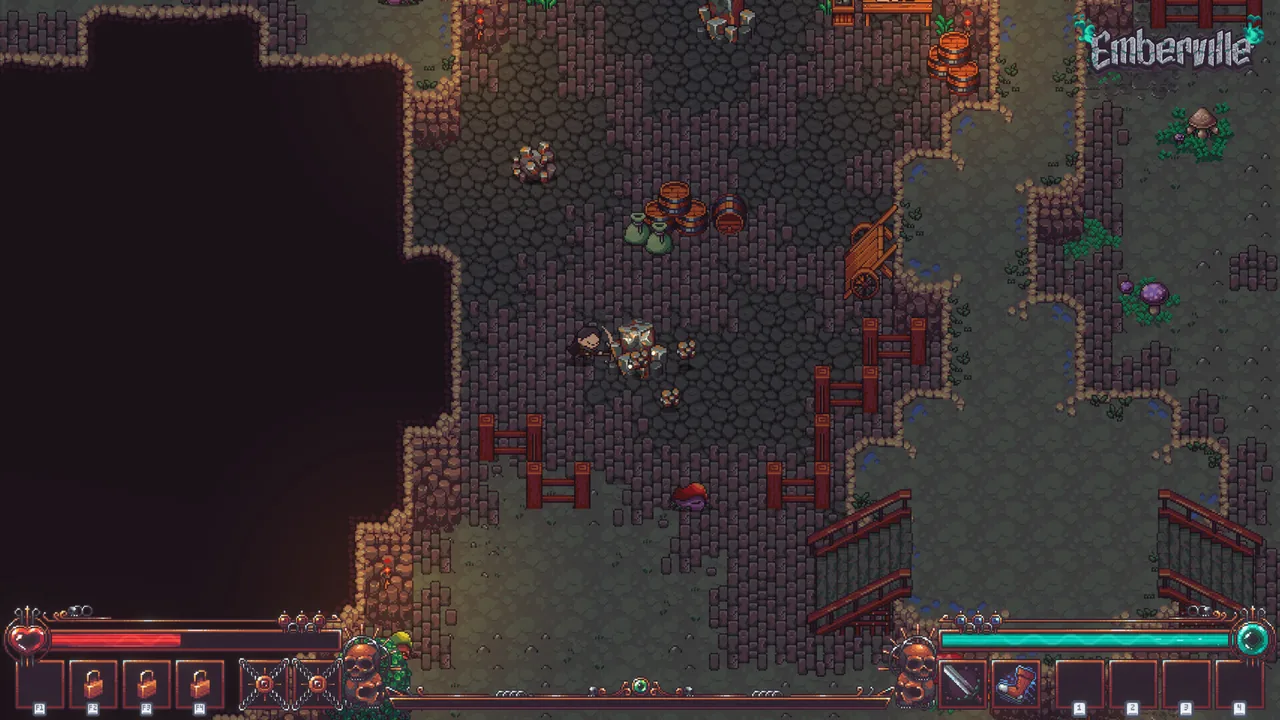
What the Vitromotus Is
Built as magical confinement "for the unwanted elements of a once great society," the prison instead testifies to "their arrogance and corruption." You wake inside with no memory; a giant crystal's interior serves as the prison walls (per the Temple of Geek prologue run). Its power feeds on hate and negative emotion, resurrecting everyone trapped inside — which is why death is temporary.
Official source: Emberville on Steam
How Runs Work
| Phase | What happens |
|---|---|
| Enter | Rooms reveal as you open or break doors — contents unknown until breached |
| Explore | Fight packs, dodge traps, smash furniture for loot, read lore notes |
| Events | Random events, survivor settlements, minibosses, treasure rooms |
| Boss | Biome bosses (Spider Matriarch first) gate deeper progress |
| Return | Haul materials and rescues back to town, craft, rebuild, dive again |
Rooms can swarm with enemies or hide a single bed with nothing — the prologue teaches you to breach carefully. Spike traps, locked spider-keys, and ambush rooms all appear in the opening hours alone.
Dungeon Features
- Procedural levels — "two descents rarely look the same": events, biomes, enemies, treasure, bosses reshuffle.
- Biomes — spider caves, ruins, labs, deserts, throne rooms and more (biomes).
- Traps and secrets — spike traps confirmed; locked doors need named keys.
- Survivor settlements — friendly pockets inside the hostile deep.
- Lore items — books and notes explaining Kymia, the prison, and its builders.
Delving Tips
- Breach doors ready — rooms reveal on entry; weapon out, dodge finger loaded.
- Break furniture — wood, coal, weapons, armor hide in destructibles.
- Learn the tells — enemy patterns reward positioning and timing over stats.
- Bank progress often — return to craft and rebuild rather than overextending.
- Death is information — the prison resurrects you; treat wipes as scouting.
Mapping the Dungeon Mentally
Because layouts reshuffle, static maps are worthless — but structure repeats. Think in layers rather than locations:
- Entry layer (prologue): prison rooms, breakables, tutorialized combat, the scripted death. Safe to learn in.
- Acolyte halls: robed enemies, spike traps, locked doors, lore density increases. First real build check.
- Boss threshold (spider caves): adds-heavy arena, consumable check, gear check.
- Surface transition: derelict rooms with lore notes, then Emberville itself.
EA's early/mid-game presumably extends this grammar — new biomes slotting between thresholds, elite rooms guarding transitions. Learn to read "what kind of room is this" at a glance: furniture density signals loot, webbing signals spiders, tanks and pipes signal labs (and tight quarters), red carpet signals something expensive guarding something dangerous.
The Survivor-Settlement Rhythm
Friendly pockets inside the deep change optimal play: push from settlement to settlement rather than attempting full clears, treat each as a checkpoint for inventory, health, and information. Rescue targets cluster near these pockets by design — the game places hope where despair peaks. If a stretch feels empty of friendlies, you are likely off the intended path (or approaching a boss).
Traps, Keys, and Doors: The Dungeon's Vocabulary
The prologue teaches three interactables that recur throughout the game. Spike traps punish autopilot — watch floors in new rooms before crossing, and note that traps plus ambush spawns combine into the dungeon's favorite kill-box. Named keys (the spider key being first) gate boss and treasure doors, which means exploration has a keyring dimension: every locked door is a promise to remember, every odd key a reason to re-sweep cleared floors. And doors themselves are information — breached rooms reveal contents only on entry, so the door is the last safe moment to prepare. Buff, eat, check weapon cards, then breach. Players who ritualize the pre-door pause die measurably less than players who kick doors hungry.
Settlements: The Dungeon's Safe Harbors
Survivor settlements inside the deep are more than flavor — they are the dungeon's save-room equivalent. Expect vendors, lore NPCs, maybe crafting basics, and always information about what lies deeper. Route every descent settlement-to-settlement: full-clear the zone around each harbor before pushing to the next, bank valuables mentally at each stop, and treat the distance between harbors as your risk budget. If two harbors feel far apart, that stretch is the dungeon telling you the next threshold (elite, boss, biome shift) is near — slow down, buff up, and breach ready.
Difficulty Curve: What the Prologue Promises
The opening arc tiers cleanly — tutorial rooms, then acolyte halls, then the Matriarch threshold — which predicts the EA curve: each biome tier introduces one new demand (adds management, then positioning, then sustain, then burst checks) while re-testing the old ones. Difficulty options are confirmed adjustable, so the intended experience is completable by story players and punishable for veterans who opt in. The practical takeaway: if a wall feels vertical, check the demand you skipped — the dungeon teaches in order, and walls are usually unread lessons, not stat gaps. Adjust difficulty down to learn, up to prove, and never let pride convert a lesson into a grind.
FAQ
How deep does the Vitromotus go?
Unconfirmed. EA covers start through early/mid-game; more depths arrive toward 1.0.
Is the dungeon different every run?
Yes — procedurally generated levels with shuffled events, biomes, enemies, treasure, and bosses.
Rooms reveal contents only on entry — weapon out, buffs eaten, weapon card checked before you open.
Sources
Related
More Emberville Guide Guides
Who makes Emberville: Cygnus Cross debut studio, CohhCarnage co-creator role, and the 22-actor voice cast with Amelia Tyler and Matt Mercer.
What Emberville EA includes at launch, what 1.0 adds — modding, bosses, biomes — and how community feedback shapes the year.
Build your Emberville estate: workbenches, furnaces, farms, decorations, and why your homestead drives dungeon progress.
Every confirmed Emberville answer in one place: release date, co-op, price, platforms, classes, permadeath, demo, and system specs.
How farming works in Emberville: crop plots, Herbalism and Farming masteries, and turning harvests into food for dungeon dives.
Fishing, Mining, Smelting, and Woodcutting in Emberville: how gathering masteries level and feed your crafting and kitchen.
How Emberville gear works: dungeon loot, forging weapons and armor, potions, food, tools, and trinkets — all pre-launch confirmed.
The Knight is Emberville's defensive melee class: Raise Shield, Counter Attack, block scaling, and how to build around it.